 Add to Chrome
 Add to Firefox
 Add to Edge
VeriScale: Adversarial Test-Suite Scaling for Verifiable Code Generation
May 21, 2026
As large language models (LLMs) are increasingly deployed for software engineering, constructing high-quality benchmarks is crucial for evaluating not just the functional correctness, but also the formal verifiability of generated code. However, existing benchmarks are limited by the quantity and quality of positive and negative test cases, leading to an overestimation of model capabilities in generating specifications and implementations. To address this, we propose VeriScale, a novel framework driven by the adversarial implementations. It consists of two stages: test-suite expansion to construct diverse and challenging test cases, and test-suite reduction to distill them into compact yet discriminative suites. While VeriScale is general, we instantiate it on Verina to construct VerinaPlus, which expands the original test suites by over 83$\times$, and VerinaLite, a lightweight 14$\times$ variant. Our experiments across eight state-of-the-art LLMs demonstrate that VerinaPlus exposes substantial model weaknesses hidden by the original benchmark, evidenced by sharp score drops on both SpecGen and CodeGen tasks, whereas VerinaLite maintains this discriminative power at a fraction of the evaluation cost. The enhanced benchmarks and source code are publicly available at https://github.com/XiaoyangLiu-sjtu/VeriScale.

MediaClaw: Multimodal Intelligent-Agent Platform Technical Report
May 14, 2026MediaClaw is a multimodal agent platform built on the OpenClaw ecosystem. Its core design follows a three-layer architecture of unified abstraction, pluginized extension, and workflow orchestration. The system is intended to address practical deployment pain points in AIGC adoption, including fragmented capabilities, heterogeneous interfaces, disconnected production processes, and limited reuse of high-quality production workflows. \system{} abstracts full-category AIGC capabilities into a unified invocation model, uses plugins to support hot-pluggable capability expansion, and uses task-oriented Skills to turn complex production processes into reusable workflow assets. This report focuses on the architectural design philosophy of MediaClaw, the design logic of its core capability model, and the key engineering trade-offs in implementation. It aims to provide reusable practical reference for building multimodal capability platforms.
Decompose, Structure, and Repair: A Neuro-Symbolic Framework for Autoformalization via Operator Trees
Apr 21, 2026Statement autoformalization acts as a critical bridge between human mathematics and formal mathematics by translating natural language problems into formal language. While prior works have focused on data synthesis and diverse training paradigms to optimize end-to-end Large Language Models (LLMs), they typically treat formal code as flat sequences, neglecting the hierarchical logic inherent in mathematical statements. In this work, we introduce Decompose, Structure, and Repair (DSR), a neuro-symbolic framework that restructures autoformalization into a modular pipeline. DSR decomposes statements into logical components and maps them to structured operator trees, leveraging this topological blueprint to precisely localize and repair errors via sub-tree refinement. Furthermore, we introduce PRIME, a benchmark of 156 undergraduate and graduate-level theorems selected from canonical textbooks and expertly annotated in Lean 4. Experimental results demonstrate that DSR establishes a new state-of-the-art, consistently outperforming baselines under equivalent computational budgets. The datasets, model, and code will be released to the public soon.
Vision-Language Models Can Self-Improve Reasoning via Reflection
Oct 30, 2024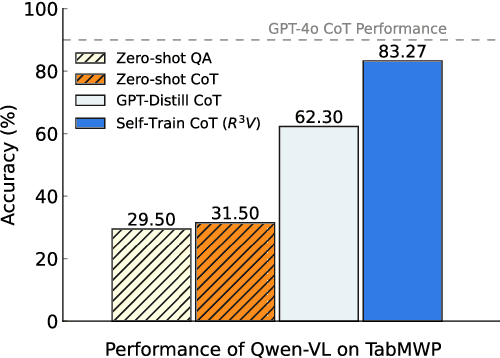
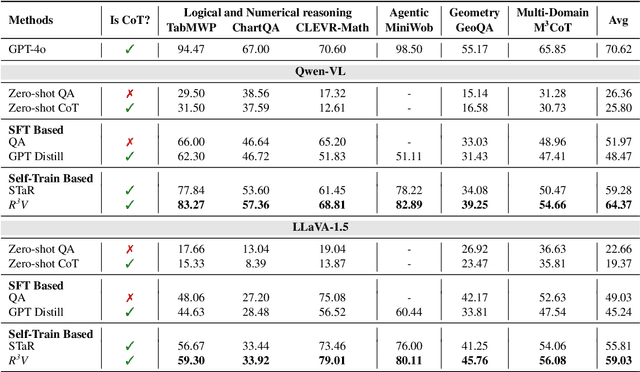
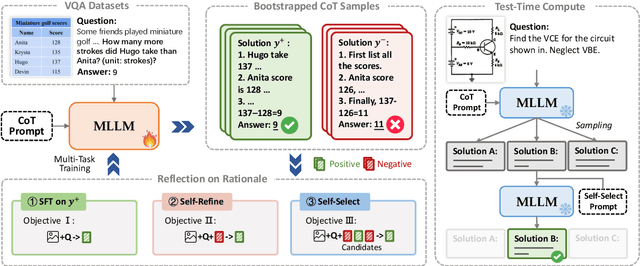
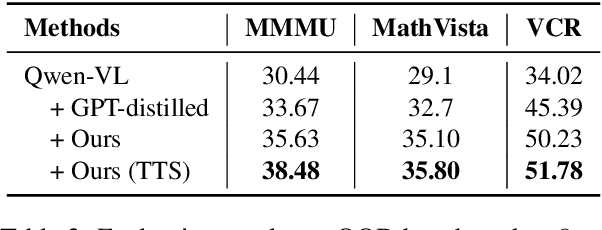
Chain-of-thought (CoT) has proven to improve the reasoning capability of large language models (LLMs). However, due to the complexity of multimodal scenarios and the difficulty in collecting high-quality CoT data, CoT reasoning in multimodal LLMs has been largely overlooked. To this end, we propose a simple yet effective self-training framework, R3V, which iteratively enhances the model's Vision-language Reasoning by Reflecting on CoT Rationales. Our framework consists of two interleaved parts: (1) iteratively bootstrapping positive and negative solutions for reasoning datasets, and (2) reflection on rationale for learning from mistakes. Specifically, we introduce the self-refine and self-select losses, enabling the model to refine flawed rationale and derive the correct answer by comparing rationale candidates. Experiments on a wide range of vision-language tasks show that R3V consistently improves multimodal LLM reasoning, achieving a relative improvement of 23 to 60 percent over GPT-distilled baselines. Additionally, our approach supports self-reflection on generated solutions, further boosting performance through test-time computation.
SeeClick: Harnessing GUI Grounding for Advanced Visual GUI Agents
Jan 17, 2024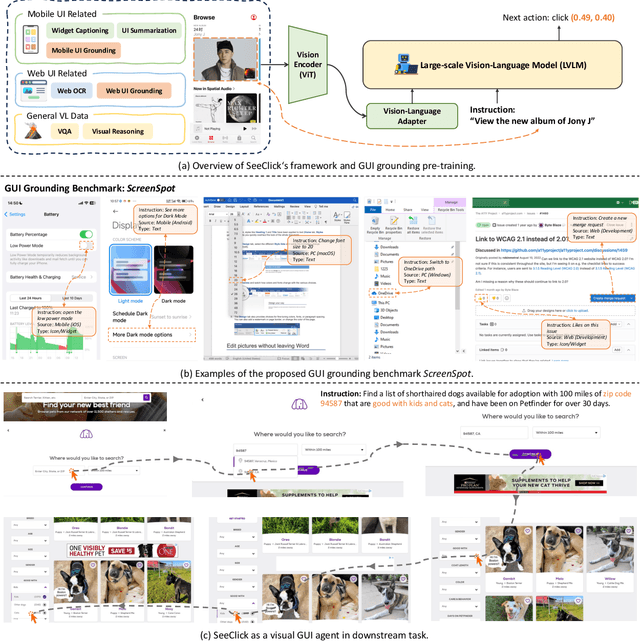
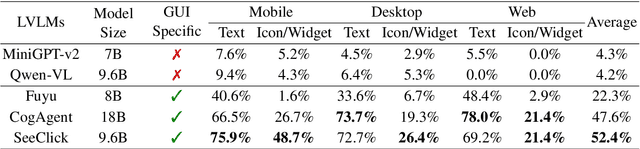
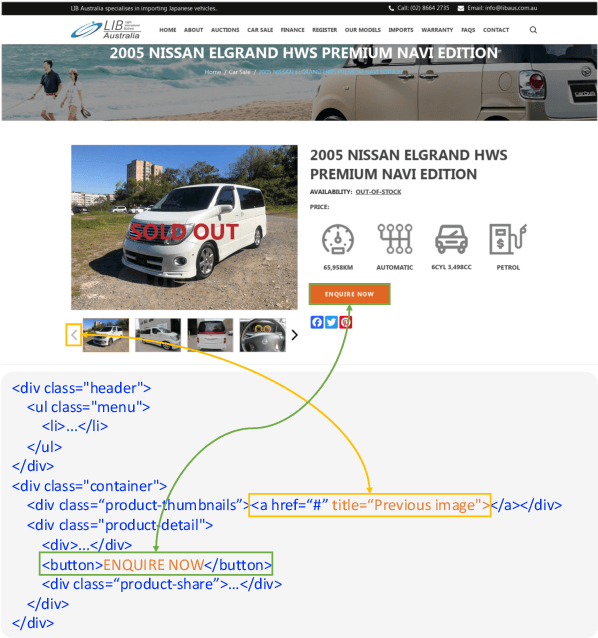
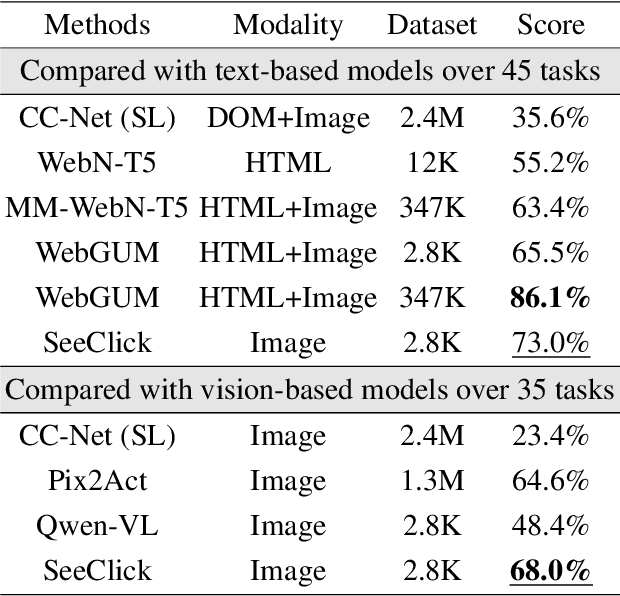
Graphical User Interface (GUI) agents are designed to automate complex tasks on digital devices, such as smartphones and desktops. Most existing GUI agents interact with the environment through extracted structured data, which can be notably lengthy (e.g., HTML) and occasionally inaccessible (e.g., on desktops). To alleviate this issue, we propose a visual GUI agent -- SeeClick, which only relies on screenshots for task automation. In our preliminary study, we have discovered a key challenge in developing visual GUI agents: GUI grounding -- the capacity to accurately locate screen elements based on instructions. To tackle this challenge, we propose to enhance SeeClick with GUI grounding pre-training and devise a method to automate the curation of GUI grounding data. Along with the efforts above, we have also created ScreenSpot, the first realistic GUI grounding dataset that encompasses mobile, desktop, and web environments. After pre-training, SeeClick demonstrates significant improvement in ScreenSpot over various baselines. Moreover, comprehensive evaluations on three widely used benchmarks consistently support our finding that advancements in GUI grounding directly correlate with enhanced performance in downstream GUI agent tasks. The model, data and code are available at https://github.com/njucckevin/SeeClick.